Big Bag Types: Standard, Q-Bag, Conductive & UN Certified FIBC Comparison
Detailed comparison of standard big bags, Q-Bags, conductive Type C, and UN certified FIBC types. Which big bag type suits your needs?
Overview of Big Bag Types
FIBC (big bag) selection should be based on the characteristics of the product to be transported, storage conditions, and regulatory requirements. In this guide, we compare the main big bag types.
1. Standard Big Bag
The most commonly used FIBC type.
Manufactured from polypropylene woven fabric.
Preferred for general-purpose bulk material transportation.
Technical Specifications
| Feature | Value |
|---|---|
| Capacity | 500 - 2000 kg |
| Safety Factor | 5:1 or 6:1 |
| Fabric Weight | 150 - 200 g/m² |
| Lifting Loops | 4 corner loops |
Advantages
- Most economical option
- Wide application area
- Easy availability
- Standardized dimensions
Disadvantages
- Stacking inefficiency (round form)
- Cannot be used in explosive environments
- Not suitable for dangerous goods
Suitable Products
Flour, sugar, grain, plastic granules, mineral powders, cement, sand
2. Q-Bag (Square-Based Big Bag)
Provides optimum stacking and warehouse space efficiency.
Square base design maximises storage utilisation.
Technical Specifications
| Feature | Value |
|---|---|
| Base Form | Square (90×90 cm, 110×110 cm) |
| Stacking | 5-6 tiers |
| Space Saving | 20-30% |
Advantages
- Stable stacking (5-6 tiers safely)
- Warehouse space optimization (20-30% savings)
- Compatibility with automatic filling systems
- Professional appearance
Disadvantages
- 10-15% higher cost compared to standard big bags
- May require custom production
Suitable Products
High-volume storage requirements, automatic filling lines, export shipments
3. Conductive Big Bag (Type C)
Antistatic FIBC designed for safe use in explosive atmospheres.
Operating Principle
Type C big bags dissipate static electrical charge through conductive threads added to the fabric during weaving. Grounding must always be done during use.
Technical Specifications
| Feature | Value |
|---|---|
| Conductive Thread | Carbon or metal content |
| Surface Resistance | < 10⁸ Ω |
| Grounding Points | 4 (each loop) |
| Compliance | ATEX, IECEx |
Usage Rules
⚠️ Critical: Type C big bags create explosion risk when used without grounding.
- Grounding connection must be checked before filling/emptying
- Grounding resistance must be < 10⁷ Ω
- Must be used with conductive equipment
Suitable Environments
- Chemical powder processing facilities
- Pharmaceutical production lines
- Metal powder operations
- Powder coating facilities
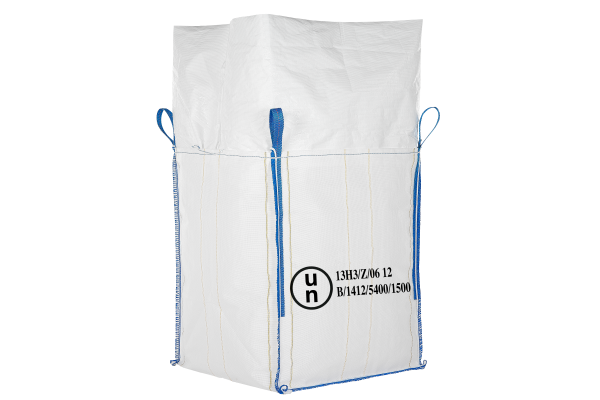
4. UN Certified Big Bag
UN approved FIBC for international transportation of dangerous goods.
UN Classification
| UN Code | Description |
|---|---|
| UN 13H1 | Open top, woven polymer |
| UN 13H2 | Fully enclosed, woven polymer |
| UN 13H3 | Open top, plastic film |
| UN 13H4 | Fully enclosed, plastic film |
Test Requirements
For UN certification, big bags undergo the following tests:
- Drop Test: Drop from 1.2 m height
- Stacking Test: Load bearing for 28 days
- Lifting Test: Lifting at 6× SWL
- Tear Test: Tear resistance measurement
- Righting Test: Positioning after drop
Regulatory Compliance
- ADR (European road transport)
- RID (Rail transport)
- IMDG (Sea transport)
- IATA (Air transport)
5. Vented Big Bag (Ventilated)
Provides ventilation for breathable products with mesh panels.
Design Features
- 1-4 side mesh panels
- Open areas for air circulation
- Flat bottom (easy unloading)
Advantages
- Prevents product spoilage
- Allows moisture release
- Ideal for organic products
Suitable Products
Potatoes, onions, carrots, garlic, wood, coal, certain agricultural products
Comparison Table
| Feature | Standard | Q-Bag | Type C | UN Certified | Vented |
|---|---|---|---|---|---|
| Cost | $ | $$ | $$$ | $$$$ | $$ |
| Stacking | Medium | Excellent | Medium | Medium | Medium |
| Explosive Environment | ❌ | ❌ | ✅ | Variable | ❌ |
| Dangerous Goods | ❌ | ❌ | ❌ | ✅ | ❌ |
| Ventilation | ❌ | ❌ | ❌ | ❌ | ✅ |
| Food Grade | Optional | Optional | Optional | Optional | Limited |
Selection Guide
Food Industry
→ Standard or Q-Bag + BRC certified production + LDPE/EVOH liner
Chemical Industry
→ Type C Conductive (explosive powders) or UN Certified (dangerous goods)
Agriculture Industry
→ Vented (vegetables) or Standard UV Stabilized (fertilizer, seeds)
Pharmaceutical Industry
→ Type C Conductive + high barrier liner + clean room production
Karaca Big Bag Product Range
At Karaca, we manufacture all big bag types in our BRC IoP AA certified facility. Our expert team helps you select the optimal FIBC configuration for your specific requirements.
Key Capabilities:
- Standard and Q-Bag production
- Type C conductive FIBCs
- UN certified dangerous goods bags
- Custom configurations
Contact us to discuss your bulk packaging needs and receive a customized quotation.
Frequently Asked Questions
FAQ on This Topic
What is the difference between a standard big bag and a Q-Bag?
When is a Type C conductive big bag required?
What is a UN certified big bag used for?
Which products are vented big bags suitable for?
Related Industry Solution
Explore SolutionsRelated Articles
What is FIBC? Comprehensive Big Bag Guide
Comprehensive guide to FIBC (Flexible Intermediate Bulk Container) also known as big bags. Types, applications, safe working load capacities and selection criteria.
BRC IoP Certification: Why It Matters for Food Packaging
What is BRC Packaging certification, why is it important, and how does it affect food industry supply processes? Detailed explanation of AA, A, B, C grading and audit process.
UN Certified Big Bag: Hazardous Goods Transportation Guide
Hazardous goods transportation with UN certified FIBC. ADR, RID, IMDG regulations, UN test requirements and proper big bag selection guide.
Phone
+90 216 479 94 78E-posta
info@karacabigbag.comAddress
Cengeldere 107, 34830
Istanbul, Türkiye