What is FIBC? Comprehensive Big Bag Guide
Comprehensive guide to FIBC (Flexible Intermediate Bulk Container) also known as big bags. Types, applications, safe working load capacities and selection criteria.
What is FIBC?
FIBC (Flexible Intermediate Bulk Container) is a flexible packaging solution designed for industrial-scale transportation and storage of bulk materials.
Commonly known as big bag, jumbo bag, bulk bag, or ton bag.
Manufactured from woven polypropylene (PP) fabric, big bags can carry loads between 500 kg and 2000 kg.
Their lightweight, durable, and cost-effective structure has made them the standard solution in bulk material logistics.
History of Big Bags
The first FIBCs were developed in the 1960s and entered commercial use in the 1970s.
Initially used for fertiliser transport in agriculture, they later expanded to food, chemical, and pharmaceutical sectors.
Today, over 500 million FIBCs are produced annually worldwide.
They continue to be the cornerstone of global bulk material transportation.
Types of Big Bags
1. Standard FIBC
The most commonly used big bag type. Transported using forklift or crane via four lifting loops. Loaded through a filling spout or open top, discharged through a discharge spout or flat bottom.
Applications: Flour, sugar, grain, plastic granules, mineral powders
2. Q-Bag (Square-Based)
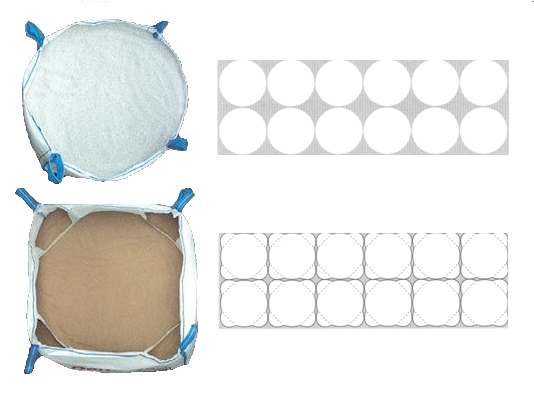
Square base design provides stackability and warehouse space optimisation. Occupies 20-30% less storage space compared to standard big bags.
Advantages:
- Stable stacking (5-6 tiers)
- Warehouse space optimisation
- Compatibility with automatic filling systems
3. Conductive Big Bag (Type C)
Designed for safe use in explosive dust and gas environments.
Prevents static electricity accumulation through conductive threads.
Important: Type C big bags must always be grounded.
Use without grounding creates explosion risk.
Applications: Chemical powders, pharmaceutical powders, metal powders
4. UN Certified FIBC
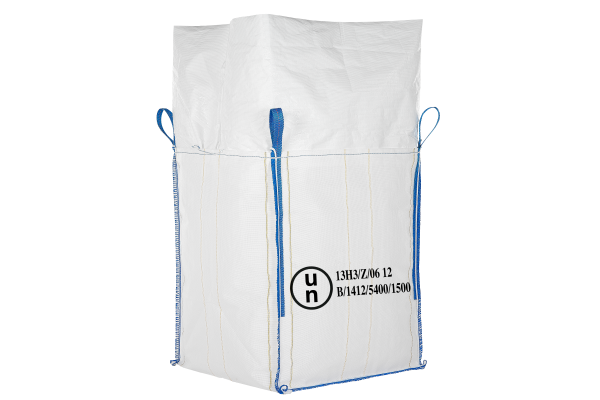
UN approved big bags for international transportation of dangerous goods. Have passed UN 13H1-H4 tests.
UN Test Requirements:
- Drop test
- Stacking test
- Lifting test
- Tear test
5. Vented (Ventilated) Big Bag
Provides ventilation through mesh panels for breathable products. Prevents spoilage of products like potatoes, onions, and wood.
Big Bag Components
Lifting Loops
Four loops at the corners enable handling by forklift or crane.
Different configurations available:
- Cross-corner loops — Most common, attached to corners
- Side-seam loops — Integrated into side seams
- Stevedore loops — Additional loops for crane handling
Body (Main Bag)
The main container made from woven PP fabric. Standard dimensions:
- Width: 90-110 cm
- Height: 90-200 cm
- Fabric weight: 150-200 g/m²
Top Configuration
- Open top: Manual filling
- Spout top: Controlled filling through spout
- Full closure: Sealed top, cut to open
Bottom Configuration
- Flat bottom: Simple discharge
- Spout bottom: Controlled discharge through spout
- Full discharge: Complete emptying capability
Specifications and Capacities
Safe Working Load (SWL)
| Capacity | Typical Use |
|---|---|
| 500 kg | Light materials, samples |
| 1000 kg | Standard materials |
| 1500 kg | Heavy materials |
| 2000 kg | Dense materials |
Safety Factor
| SF Ratio | Description |
|---|---|
| 5:1 | Single-trip use |
| 6:1 | Multi-trip or demanding conditions |
Selection Criteria
1. Product Characteristics
- Bulk density
- Moisture sensitivity
- Chemical reactivity
- Particle size
2. Handling Requirements
- Forklift or crane?
- Stacking requirements
- Filling method
- Discharge method
3. Regulatory Requirements
- Food contact (EU 1935/2004, FDA)
- Dangerous goods (UN certification)
- Explosive atmospheres (Type C)
4. Environmental Conditions
- UV exposure
- Humidity
- Temperature range
Quality Standards
BRC IoP (Packaging)
For food-contact big bags, BRC certification ensures hygienic production and full traceability.
ISO 21898
International standard for FIBC design, construction and safe use.
UN Packaging
For dangerous goods transport, UN 13H certification is mandatory.
Karaca Big Bag Capabilities
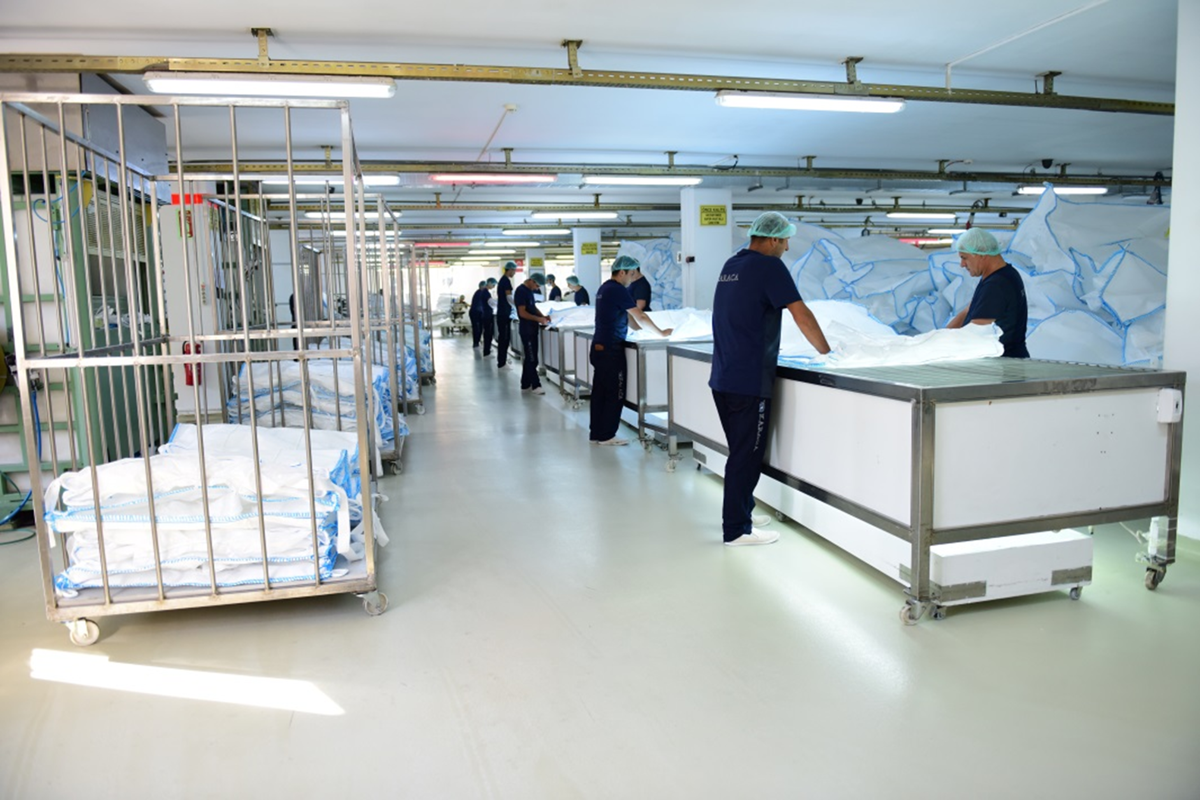
At Karaca, we manufacture a full range of FIBC types in our BRC IoP AA certified facility:
- Standard and Q-Bag configurations
- Type C conductive FIBCs
- UN certified dangerous goods bags
- Food-grade lined big bags
- Custom specifications
Contact us to discuss your bulk packaging requirements.
Frequently Asked Questions
FAQ on This Topic
What does FIBC stand for?
How much weight can a big bag carry?
What are the different types of big bags?
Which industries use big bags?
Can big bags be reused?
Related Industry Solution
Explore SolutionsRelated Articles
Big Bag Types: Standard, Q-Bag, Conductive & UN Certified FIBC Comparison
Detailed comparison of standard big bags, Q-Bags, conductive Type C, and UN certified FIBC types. Which big bag type suits your needs?
BRC IoP Certification: Why It Matters for Food Packaging
What is BRC Packaging certification, why is it important, and how does it affect food industry supply processes? Detailed explanation of AA, A, B, C grading and audit process.
UN Certified Big Bag: Hazardous Goods Transportation Guide
Hazardous goods transportation with UN certified FIBC. ADR, RID, IMDG regulations, UN test requirements and proper big bag selection guide.
Phone
+90 216 479 94 78E-posta
info@karacabigbag.comAddress
Cengeldere 107, 34830
Istanbul, Türkiye